
Written by Nolan Ryan
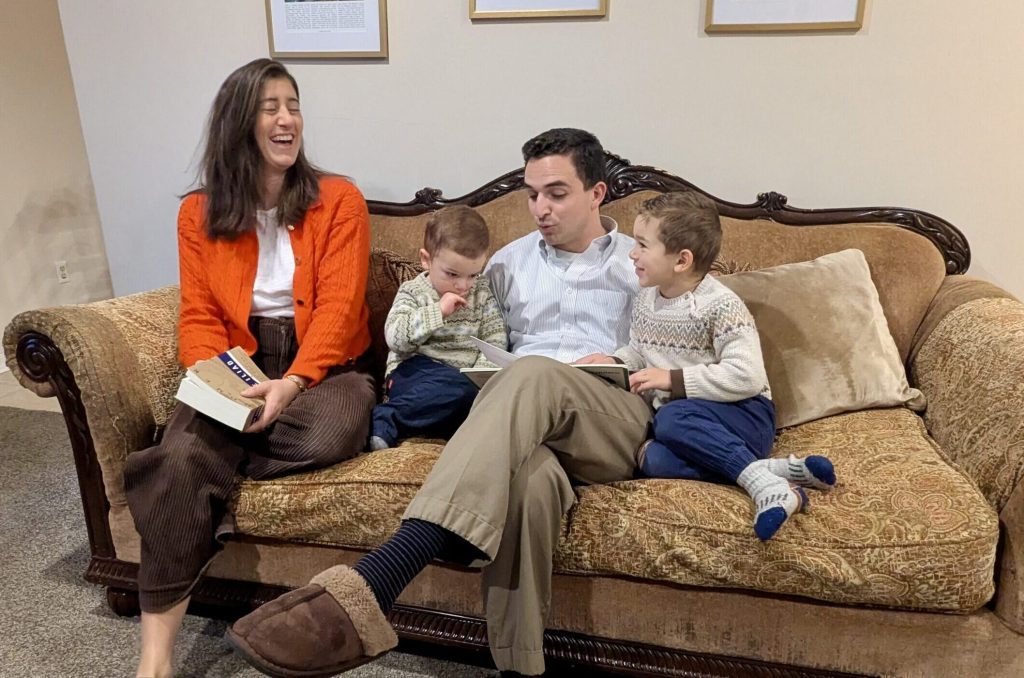
As Hillsdale College students approach their senior year, some of them look to begin graduate school after they leave campus. But for many of Hillsdale’s graduate students, the transition from undergrad to grad school was not immediate. In the Diana Davis Spencer School of Classical Education program, a handful of residential grad students have not only begun careers, but many also started raising children before attending grad school.
Parents in the program have had a variety of considerations before pursuing their master’s degree in classical education. Every family has had to figure out, through trial and error, how grad school fits into daily life and routines.
Treating Grad School as a Full-Time Job
Sydney Tone Hunter, ’22, B.S., ’26, M.A., had been staying at home with her son while her husband worked full time, when the couple moved back to Hillsdale several years after they graduated. In fact, Brooke Tonne Roe, ’11, B.A., ’27, M.A., Hunter, and other parents picture their time in grad school as a full-time job. This has been a helpful way to approach grad school as a whole, from time management to financial management.
Hunter and Felipe Trebilcock, ’26, M.A., both structure their days in grad school as if their weekdays are 9-5 workdays. Both begin their grad school work in the morning and return home to their families by early evening. Roe does the same, which has required her husband to take on the role of preparing weekday dinners so she could work on campus until then. “Then I help from dinnertime to getting the kids to bed,” Roe said, “and we do the whole bedtime routine together.”
Meanwhile, Hunter said she spends her weekends with her son and running errands. “It has required adaptation from being an undergrad student, where my main work time was on the weekends,” she said. “Sometimes I get more done on weekends; other times, I don’t. The tricky part is fully engaging with whatever I’m doing at the time and not multitasking.”
For Ben Weide, ’21, B.S., ’27, M.A., he completes much of his work early in the morning. This is not so different from when he was teaching high school before returning to Hillsdale for grad school. “When I was teaching, I had to get up between 5:30 and 6:30,” he said. “Generally, teachers are busy, so I did not think about having extra time in the morning.” The early morning usually includes reading or exercise before his youngest child wakes up.
For Weide and his wife, having younger children has helped make grad school work for their family. “As a family, we’re not in that stage where we have things going on out of the house,” he said. “And my wife has flexibility. It’s easier as a father to be the one who is gone 10 hours a day working.”
Navigating the Realities
The biggest challenges for parents in the program, as for most grad students, are making things work financially and having finite time for family, school, and work. Weide has found grad school less stressful than teaching, but “there is still a triage that has to happen. I may just have to not finish this reading today because I’m potty training my daughter. But being a parent requires you to become better at managing your time than you were in undergrad,” he said.
Several parents in the grad school point to community support as making their education possible. Hunter said many parents put together a childcare routine with the help of Hillsdale students, the church, and other parents. For example, Hunter’s mom can consistently watch her son. Trebilcock said his family has found a good community in their church and in the college. “My wife has a lot of support,” he said. “Community helps the family. Hillsdale is a great place to raise a family.”
Roe said she and her husband decided to move to Hillsdale not only for the program itself but also because no other location where they looked at grad schools “had the built-in community we already knew.” They attend the same church as they did when they were in undergrad and already had friends in Hillsdale. “So many families are still here or moved here from places we’ve already lived,” Roe said. “There are overlapping social circles,” she said, which makes it easier for her children to make friends.
While the challenges of parenting in grad school are present in any academic program, Hunter said that the classical education program “is as child-friendly as it could be. Professors are all understanding, like if you miss some classes because your kid is sick. I appreciate the more humane side.” She attributes this to the culture of the Hillsdale community. Most people on campus are “pro-life, pro- getting married young, and pro- having children, so it’s a freer atmosphere,” she said. “Professors and staff here rejoice that there are people with families.”
Aside from the unique challenges and the potential community support, some grad students recognize in their continuing education a positive benefit for their parenting and their marriages.
Roe said the program has not only met a need for deep reading and discussion, but it has also transformed her marriage. The program has allowed her and her husband, in a way, to experience each other’s lives. The two taught together before they were parents, but after adopting their children, Roe’s husband continued to teach and work in academia, and she transitioned to the role of stay-at-home mom. Now, Roe experiences the work of academia, while her husband, on top of his current job, tends to cooking, laundry, and other household needs. “Neither one of us had been in the position where we could cross paths completely while parents. This has been, in a way, transformative to our marriage,” Roe said. “We both understand each other more. Now that we both know what the other person has been feeling, we can ask what we want the next five, 10, 15, 20 years to look like.”
And when it comes to growing as a parent, Trebilcock noted that “education is the same enterprise when teaching and when parenting, at least in essence. I ask myself all the time in class, ‘What are the implications of this when raising my own family?’” Trebilcock, for example, believes taking courses in phonics and in children’s literature will especially help him as a father.
In a similar manner, Weide joined the program, he said, “not to become a better technician” but to spend two years becoming a better person and to cultivate virtue. He recalled a point this year when he noticed his education had positive effects on his interactions with his wife and children. “I’m constantly thinking about how I can live up to this Ciceronian or Homeric ideal—not just as a teacher, but as a husband or father.”
For Weide, as for other grad students with children, the formation in virtue is a key part of his time in grad school. “If you’re interested in the program as a means for intentional character formation, it will be a net positive for your family,” Weide concluded, “because being a better teacher is intimately wedded to being a better husband and father.” The parent and the teacher, Weide noted, both need the same qualities and virtues. “The classical education program itself is focused not on making you a better technician, except incidentally. It is focused on making you a leader.”
Nolan Ryan, ’27, M.A., is a 2020 alum and a graduate student studying classical education. He taught English and history at a classical school in Texas for five years before moving back to Michigan. Usually, you can find him reading C.S. Lewis or Augustine at Rough Draft and sipping on a bourbon vanilla latte.
Published in February 2026
