
Written by Adam Robbins
Have you ever wondered what goes on behind the scenes of a Hillsdale College theatre production? Curiosity allowed me to peek behind the curtain. I learned about the community living behind the stage, collaborating and growing through the fun and fulfilling process of bringing performances to the audience. Stepping behind the curtain allowed me to understand how the Department has cultivated a robust community among a variety of students studying many different things, who bond over a general love of theatre.
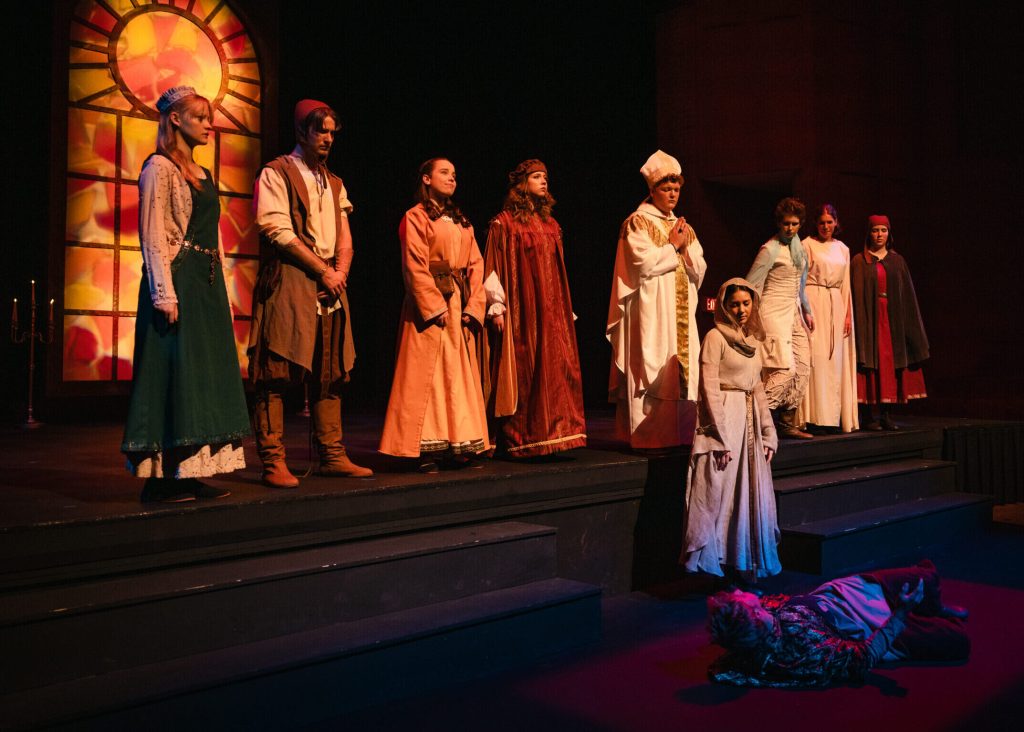
Ava Jolly, ’27, gladly took me behind the scenes where I watched the Tower Players rehearse the fall 2025 production of Everyman. Jolly is pursuing a theatre minor, and I got to watch her work with the actors and director as one of the two stage managers.
When Jolly first started at Hillsdale, she wasn’t sure about pursuing theatre as part of her degree, but she soon realized that she “loved the people and the act of putting on a performance from both a crew and actor’s perspective.” The process of adapting to roles under the guidance of professors has made theatre a great opportunity for her to grow and build confidence. Because of those experiences, she hopes to pursue theatre in some form professionally after graduation.
Rachel Dunphey, ’26, another four-year member of the Tower Players, gained a similar appreciation for the Department and its unique open audition policy. “Even at a small college like Hillsdale, we still have immense theatrical talent and students who are extremely dedicated to their craft,” Dunphey said. The Department balances the fun of producing art while also cultivating the discipline that it takes to master it. For Dunphey, these aspects lead to productions that nurture a community that is both skillful and tight-knit behind the stage.
During the rehearsal, I was surprised by the overwhelming enthusiasm with which the students jumped into their roles and adjusted to the director’s guidance. I got to see firsthand the talent and dedication Dunphey described, and I was really impressed. The fun way in which students and the director bantered and collaborated with each other showed me a glimpse of that community that Jolly loves. As the rehearsal came to a close, I began to wonder how the Department established such a talented and pleasant community of students.
Dr. Christopher Matsos, chairman and associate professor of theatre, told me how the small but diverse faculty has the experience to offer classes that you would not usually find outside of a dedicated conservatory. The faculty teaches with a focus on the history and values of theatre, but each in their own unique way. Dr. Matsos explained how each professor also has their own style of conducting a rehearsal, but the Department works to cultivate a fun and comfortable environment. “My role, along with the other professors, is to get out of the way when necessary, and make sure students get the space they need to be creative,” Dr. Matsos said.
This was consistent with how Dr. James Brandon, professor of theatre, guided students in the rehearsal of Everyman. Dr. Brandon advised students on how to speak, prepare their voices, and where to stand, but a lot of the actions and minute expressions of the characters came from the students taking on their roles and making them their own. “Learning a role means the actor is extremely familiar with the character’s backstory, circumstances, and feelings,” Jolly said.
According to Dr. Matsos, theatre productions are planned a year in advance to accommodate considerable rehearsal periods and coincide certain performances with events like Parents Weekend. Rehearsal periods are four to five weeks long, and students practice for about three hours per day. The number of students in a rehearsal depends on the size of the cast and type of rehearsal. The cast can include up to 30 actors with up to 25 student crew members including stage managers, costume crew, and stage hands.
The rehearsal space and production process reflect a unique aspect of Hillsdale College’s tight student community, where you can expect to meet your peers in the hall, on the field, in the classroom, at AJ’s Cafe, in a club meeting, and behind or on the stage. The Tower Players’ open audition policy brings together students from all majors, clubs, and friend groups. “The best part about being involved in theatre is making friends and finding a family in your fellow actors or crew,” Jolly said. “I have met some of my best friends through the Theatre Department.”
“The Department is growing as the Tower Players auditions have seen a marked increase in students wishing to participate onstage or backstage,” Dr. Matsos said. The Department is poised to facilitate even more students both on the stage and in the classroom. Theatre’s role in Hillsdale College’s core curriculum helps all students understand the importance and beauty of the tradition, but the open audition policy of the Tower Players lets students be an active part of that tradition.
My exploration into the world behind a performance showed me how the Hillsdale College community floods every niche. Next time you see a Tower Players production or hear about how great they are from a friend, know that there is a talented community of students from every major telling jokes, working hard, and growing through their college experience. Hillsdale’s Theatre Department creates opportunities for students to connect and grow together in that quintessentially collegiate way while also promoting the school’s liberal arts goals.
Adam Robbins, ’27, hails from Atlanta, GA, and enjoys writing short stories and poetry, reading, and the English language. He plays classical guitar and specializes in Classical, flamenco, and Spanish music. His favorite author is Dostoevsky, and he enjoys studying literary and philosophical works from across the ages. He likes to spend his warm sunny days golfing with friends or going on walks.
Published in March 2026
