
Written by Nolan Ryan
You cannot lead students to love something that you don’t love yourself. This is a key principle in classical education, and Hillsdale’s Diana Davis Spencer Graduate School of Classical Education aims to help deepen teachers (and future teachers) in a love of our cultural heritage and Western tradition. The residential program provides graduate students with a strong foundation in history, philosophy, and literature, while also giving them greater experience in pedagogy, curriculum, leadership, and school culture. For the students, this training comes back to love and friendship: love of ideas within a community of friends.
Students will engage with works throughout all of Western educational history, from Plato to Mark Van Doren, which means a wide variety of reading during the two years of the program. In their first year, students read an essay, “On Running After One’s Hat,” in which G.K. Chesterton writes that “an adventure is only an inconvenience rightly considered. An inconvenience is only an adventure wrongly considered.” The rigorous reading and writing requirements might seem like an obstacle to overcome, but when students read from a place of wonder and leisure, they get to sail home with Odysseus; they get to wrestle in conversation with Plato and Aristotle.
On the course readings, Aidan Jones, ’26, M.A., said they are both a great challenge and a great delight—a point echoed by many of the students. By the time undergraduates leave Hillsdale, they are used to hearing Hillsdale’s motto “Virtus tentamine gaudet.” The opportunity to rejoice in the challenge, however, is not unique to the undergraduates; the students are well acquainted with challenges during their two years on campus. But students get to meet these challenges in community.
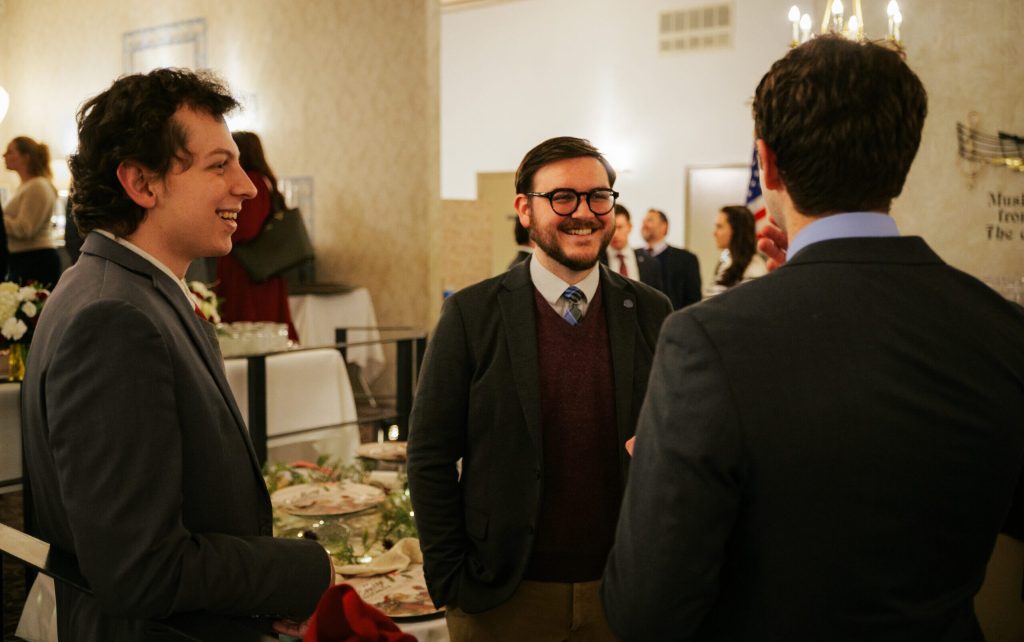
The love of great ideas and great stories does not exist in a vacuum. If you ask a student in the residential program what has had an impact on their experience, they will mention not only the rigorous readings but also the community. Camaraderie and friendship among the students are born inside and outside the classroom. Caitlin Filep, ’27, M.A., recalled a moment at the end of a class when a professor asked each student to share a favorite book and why it was a favorite. This moment helped her make connections between the classroom and community: “Maybe teaching is just love for the things we’re teaching and love for one another.”
The residential program is built around a cohort model in which an incoming group of students takes largely all of the same classes. The small and intimate cohort model is a gift, Jones said. While it takes time for people “to get to know one another, to open up and share life together,” the cohort helps this happen much more quickly. Students can expect to know each other well by the end of their first year, especially since they take the same classes together that year. In their second year, students have more room to choose electives and may not share all of the same classes, but they still take required courses as a cohort.
Filep added that the cohort model creates a tight-knit community because of—not despite—the various backgrounds of classmates. “We are all committed to the same things,” Filep said. “We have people from different backgrounds: different states, some have families, some are single, and some have teaching experience already. We all came because we wanted to be educated and refined. All of us have some kind of educational experience, and our unique educational backgrounds show what classical education looks like in different contexts.”
Students thrive in the cohort when they participate with their classmates wholeheartedly. The model requires you to be intentional about your relationships and getting to know your classmates. The residential program’s orientation sessions highlight the importance of community, though, as Filep put it, you cannot expect community to “just happen” without putting in effort. “These are wonderful people,” Filep said. “They are forming you every day; they are forming your education, as much as the professors are, for two years of your life.”
Beyond classes, residential students enjoy one another’s company in a variety of ways. Each Wednesday, for instance, the graduate students and their professors gather together to hear from a visiting speaker or Hillsdale professor on some facet of classical education. This time serves as a good touch point for everyone in the program and allows students and professors to enjoy good conversation with one another. Students also enjoy each other’s company outside of campus life—from dinners to movie nights or studying at the local coffee shop Rough Draft—but the main thing is camaraderie.
Students also spend time together through the Paideia Society, a social group that organizes events and promotes community among both first- and second-year students. The cohorts may gather for a scavenger hunt or perhaps some cider and snacks. Around a bonfire, eating good food, the students are equally at home cracking jokes as they are debating the merits of the Socratic method.
What happens in the classroom and what happens around the bonfire inform one another. Although reading assignments are necessary, Jones said that, in the moment, reading Lucretius or Aristotle sometimes should be set aside for a conversation with a classmate. This makes sense; reading or learning about a subject is not something humans should do only because they are required. What we learn should have a real effect on how we interact with others. Being a graduate student in the residential program means more than knowing and debating Aristotle. It means learning for the love of learning and for the sake of blessing those around you.
Nolan Ryan, ’27, M.A., is a 2020 alum and a graduate student studying classical education. He taught English and history at a classical school in Texas for five years before moving back to Michigan. Usually, you can find him reading C.S. Lewis or Augustine at Rough Draft and sipping on a bourbon vanilla latte.
Published in December 2025
