
Written by Nolan Ryan
Educational technology has become a billion-dollar industry that affects classroom practices, curriculum, assignments, gradebooks, and the like. In fact, many schools are required to incorporate technology in the classroom and in daily functions, as many accreditation organizations include it as part of the accreditation process.
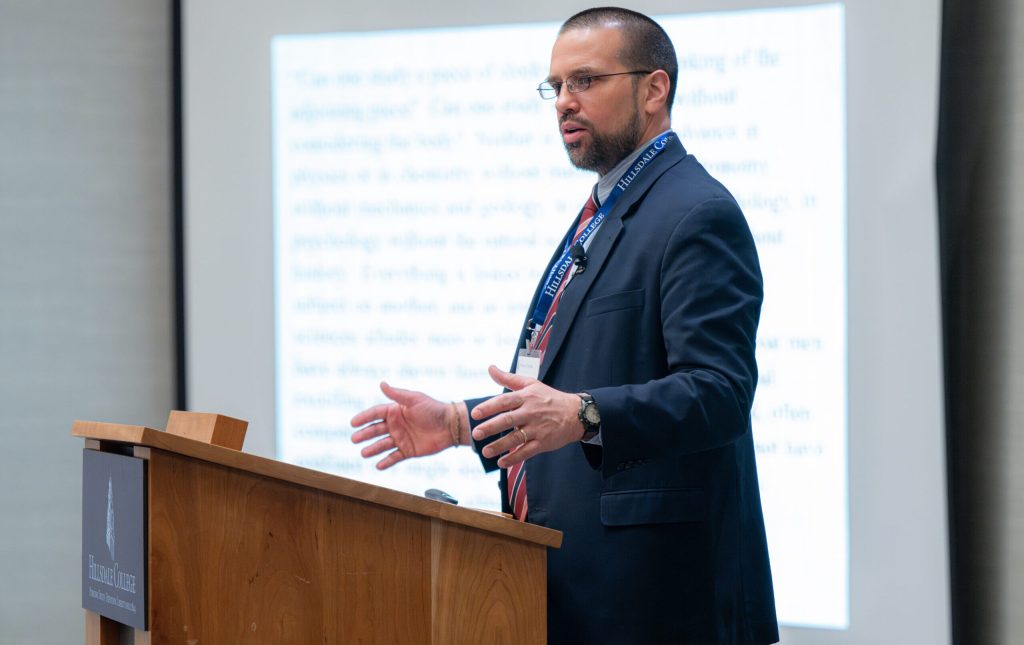
Given these realities about the current state of education and technology in culture more broadly, Dr. David Diener, associate professor of education, is teaching a course in the spring 2026 semester titled Education, Technology, and Human Flourishing. He argues that school administrators have largely not thought critically about the role technology plays in schools. “We’ve accepted a bunch of assumptions about the role technology should play in education, many of which are faulty,” he says.
One concern for Diener is that schools tend to focus too little on foundational questions concerning technology. For instance, the conversation about AI and other digital technologies has focused primarily on practical uses. Diener offers a couple of examples: “How do we keep students from cheating on papers? Should students be allowed to use AI to do research?” The impulse is to ask what AI may and may not be used for. These are fine questions, but even in “low-tech” classical schools, Diener says thinkers and leaders need to spend time on more fundamental questions about technology, particularly the digital technologies of our own era.
Each new technology is invented to serve a perceived need, but the technology, especially a digital one, will have effects beyond what its inventors anticipate. “All technologies, or at least many of them, take on a life of their own and affect human beings in ways we couldn’t have predicted and, a lot of times, couldn’t have controlled,” Diener says. “It’s very much like a Frankenstein kind of situation. We create a tool that we think is for ‘purpose A,’ and then it ends up having effects on society and on patterns of behavior that nobody could have predicted.”
We might trace these concerns back to Plato. In the Phaedrus, Socrates worries that the technology of writing would cause humans to outsource their faculty of memory. Diener notes that Plato’s concern is that we will think we know things when, in reality, we don’t, but digital technologies are fundamentally different from writing.
Most of the digital technologies of the 21st century are “totalitarian in nature.” For example, unlike a hammer, which has a relatively limited range of function, digital technologies pervade all aspects of daily life. “The issue with technologies like the Internet or AI or smartphones,” Diener says, “is that they pervade so many aspects of human life that their effect is much more extensive, and it’s very difficult to put it back in the box.” Where a landline telephone on the wall is more like a hammer in its limited uses, the smartphone is entirely different because it affects “how you engage with reality, with other people, and with the world around you.”
Seeing the pervasive effects of contemporary digital technologies, Diener’s vision is that through the course on technology, students will think more carefully through the assumptions we make about technology in the classroom and in our lives. We need to consider, he says, how any technology may affect the goal of human flourishing. As Diener says, technology, education, and human flourishing are connected “because for classical education, the goal or teleology is to cultivate a virtuous human being who is equipped to live well—to flourish as a human being.” And technology in the 21st century seems to be drastically changing society’s notions about human flourishing.
In order to develop a framework for thinking about technology and its relationship to human flourishing, the first part of the course focuses on a group of 20th-century thinkers known as “media ecologists.” This group includes figures such as Neil Postman, Walter Ong, Marshall McLuhan, and Jacques Ellul.
These men, Diener says, provide a perceptive framework by which to consider technology and its effects. While thinkers like Postman or McLuhan were concerned about radios and televisions (they didn’t have, after all, smartphones and social media), they still had remarkable foresight about how communication technologies shape us and our world. “They have a kind of prophetic voice,” Diener says, “in which they are trying to understand the fundamental nature of technology—what it is, how it works, how we interact with it. This framework is incredibly applicable for the technologies that we face today.”
As the class establishes a framework for technology as a whole, Diener wants students to carefully consider how it affects our interactions with the world, with other humans, and, ultimately, with God, as well as the effect contemporary technology has on one’s spiritual walk. The idea is to examine how technology influences human beings in all aspects of their lives.
In the classroom, then, “the question to ask about a smartboard is not ‘will this enable me to write faster’; the questions a school should ask regarding smartboards are ‘how will this change the educational experience’ and ‘how will this form the student?’”
As students think about the implications of technology in daily life and in classrooms, they will also put into practice things they discuss in the course. Diener’s students will complete two “technology fasts,” the first time for a day and the second for a week. Students will fast from a form of technology and write a series of journal reflections and a paper on what insights they glean from the fasts.
For these students who go on to teach, and for current teachers in classical education, Diener emphasizes the need to have informed stances and a positive vision. “We have to develop a thoughtful rationale for why we do or do not implement certain contemporary technologies in our classrooms,” he says. “Many of the ‘educational’ technologies that schools use turn out not to have great educational effect, and we need to make the case that we use the technologies we use to better the system of education and to cultivate the kind of humans we say we’re trying to cultivate.”
Nolan Ryan, ’27, M.A., is a 2020 alum and a graduate student studying classical education. He taught English and history at a classical school in Texas for five years before moving back to Michigan. Usually, you can find him reading C.S. Lewis or Augustine at Rough Draft and sipping on a bourbon vanilla latte.
Published in March 2026
