

Written by Grace Canlas
“A good moral character is the first essential in a man…It is therefore highly important that you should endeavor not only to be learned but virtuous.” This advice given by George Washington to his nephew, George Steptoe Washington, embodies the spirit of Hillsdale College—the education, or “leading forth,” of students in pursuit of moral virtue and self-government. It is by learning from the Greatest Teachers, described by Dr. Arnn as “discovering the right way by reading the greatest books by the greatest minds in history,” that we come to know, love, and participate in those things which are highest—the Good, the True, and the Beautiful.
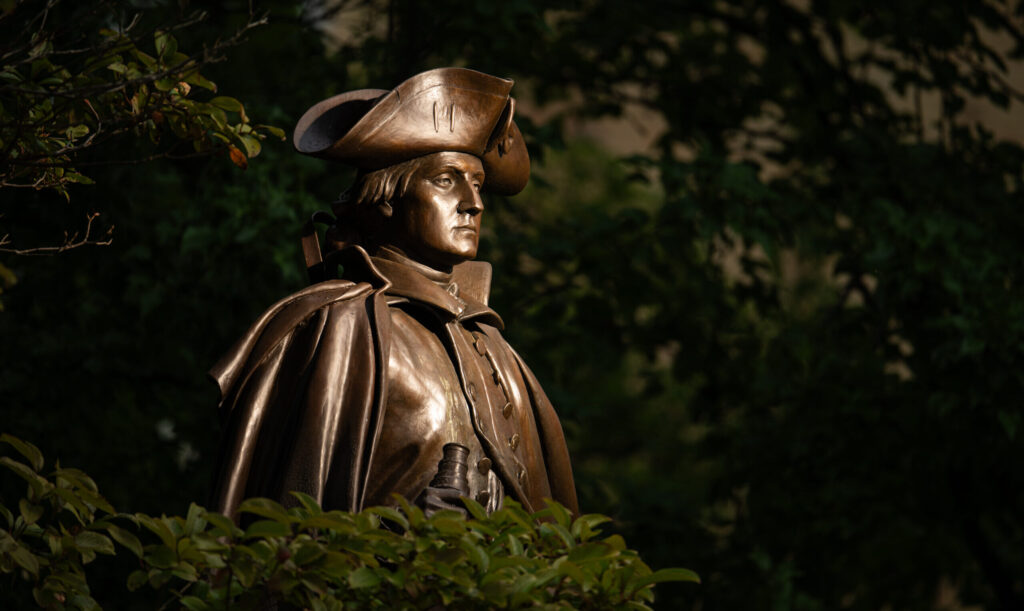
In preparation for their Hillsdale College education, incoming freshmen are instructed to read two books over the summer: Aristotle’s Nicomachean Ethics and Richard Brookhiser’s Founding Father: Rediscovering George Washington. Both works provide a foundational introduction to the formation of moral character—Aristotle describes the principles of virtue and George Washington demonstrates the activity of virtue. Out of all the greatest teachers in history, Hillsdale College has intentionally selected George Washington as one of the first teachers its students encounter in their classical liberal arts education. Dr. Matthew Spalding, Vice President of Washington Operations and Dean of the Van Andel Graduate School of Government at Hillsdale College, discusses what makes George Washington one of our greatest teachers and why he should be one of yours, too.
Reflecting on George Washington’s contribution to the American Heritage, Dr. Spalding commented on his remarkable integration of the intellectual and moral virtues. He said, “I think [George Washington’s] great contribution is he combined those two things; that is, he was very thoughtful and understood the principles of the American Revolution—which means the Western principles that gave rise to the Revolution—but then he knew how to actually bring them into being.” Dr. Spalding proposes that “If the Declaration of Independence was ‘an expression of the American mind,’ as Jefferson called it, George Washington was its embodiment.” Consequently, Dr. Spalding described Washington leaving a legacy as “the Statesman.”
It is impossible to overstate the extraordinary character and unparalleled leadership of George Washington, which raises the question, “Would there be an America without Washington?” Dr. Spalding thinks not. “It’s unclear whether the American founding would have happened, whether the revolution would have been successful, whether the constitutional convention would have held together, and whether America would have launched off on this great success that it has become.” Without Washington, it is highly probable there would be no U.S., which means there would be no us. As Americans, George Washington’s story is a part of each of our stories.
Throughout every position he held in service to his country, George Washington modeled greatness by pursuing goodness. His generalship teaches us the virtues of courage and perseverance. His statesmanship teaches us the virtues of prudence and magnanimity. His citizenship teaches us the virtues of humility and civic friendship. Deliberating upon these virtues, Dr. Spalding highlighted Washington’s exceptional cultivation of prudence. As the “chief cardinal virtue of dealing with politics,” prudence demands both embodying the moral virtues and “applying ideas in particular circumstances.” It was this prudential judgement, “what Washington had in spades,” that empowered him to successfully lead his soldiers in war and well govern his countrymen in peace.
“The American founding wasn’t an academic exercise; it was an actual thing,” said Dr. Spalding. Therefore, studying the generalship and statesmanship of George Washington “always has been important [and] always will be important” for American citizens because these models still direct us toward goodness, truth, and beauty.
While Dr. Spalding now serves as Hillsdale College’s faculty expert on George Washington, becoming a scholar on George Washington was not his intention. In graduate school, Dr. Spalding observed his fellow students writing on Hamilton, Jefferson, and Madison—
“all the harder founders” who wrote intense books and extensive works. Considering this, he thought to himself, “Well, I’ll do George Washington. He’s bound to be easier.” Plot twist: he was, in fact, not easier. As a result of the sheer amount of time George Washington served in leadership positions, “he writes more than the other founders—in many cases, the other founders combined.” However, in his undertaking of this endeavor, Dr. Spalding encountered the beauty and power of George Washington’s writings. The “great story” of George Washington captivated Dr. Spalding, “and so I just kept at it and tried to master all of his works and his life as much as I could.”
Recounting his experience studying the writings, virtues, and life of George Washington, Dr. Spalding said, “You really just get to fall in love with it.” We hope you will, too.
(To hear more about George Washington from Dr. Spalding, you can watch his segment of The Story of America video series, a partnership of Hillsdale College and the White House Task Force 250, celebrating the story of American Independence.)
Editor’s note: This is a new series featuring the greatest teachers.
 Grace Canlas, ’27, is pursuing a major in history and double minor in psychology and military history and strategy. When she’s not studying, Grace can be found practicing martial arts or laughing with her family and friends.
Published in September 2026
