

Written by Lauren Bixler
“I told my students on day one—I’m not selling anything; this is not a souk; I’m not peddling my wares. I want the students to think, and I’m here to facilitate that.”
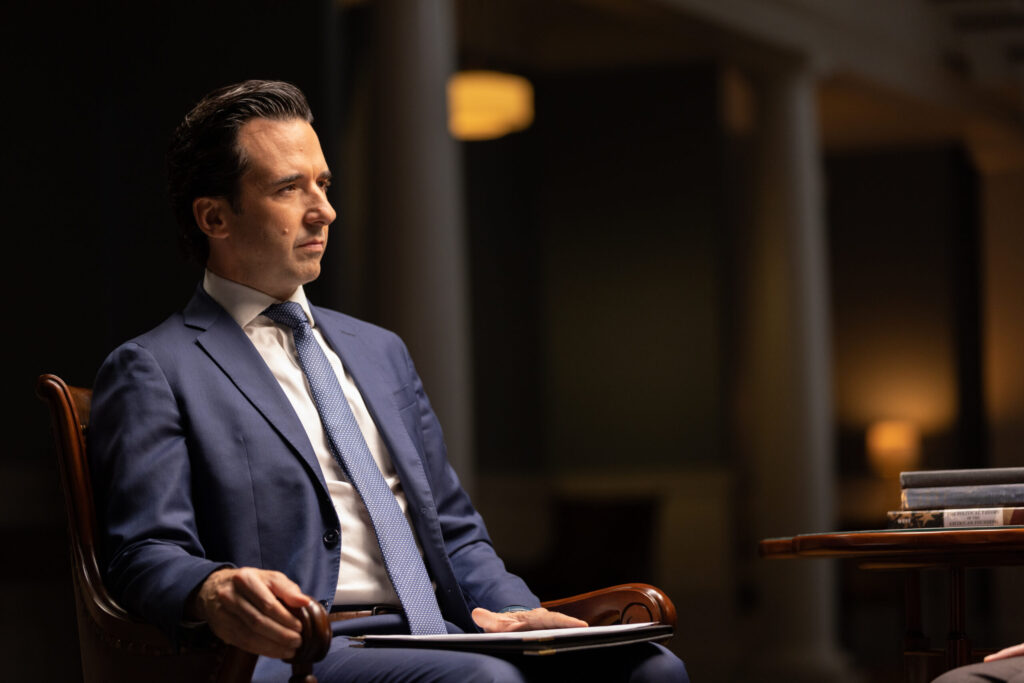
Few students at Hillsdale can say they’ve had the pleasure of taking a class with Dr. David Azerrad, Associate Professor and Research Fellow at Hillsdale College’s Van Andel Graduate School of Government in Washington, D.C.
With fiery Mediterranean blood and a heart for America (as a recently naturalized citizen originally from Canada), Dr. Azerrad is exclusive to the Hillsdale students in Washington, D.C.—either as undergraduates on the semester-long Washington-Hillsdale Internship Program (WHIP), or as graduate students in the Van Andel School of Government.
Dr. Azerrad’s specialty is American political thought—though that path was not always apparent to him.
He was born and raised in Montreal, Canada, where his parents immigrated independently of one another. His mother is from Northwestern France and Brittany, and his father is a Sephardic Jew from Morocco. Hence the fiery Mediterranean blood, as he sometimes brings up in his classes.
As Dr. Azerrad entered early adulthood, he was drawn to America for graduate work. He began pursuing his Ph.D. in political theory at the University of Dallas (UD) in 2004, but without a clear plan for where that education would lead him. “Would I stay in America? Would I go back to Canada? That was not on my mind. I was 26 years old, and I was interested in studying political theory,” he recalled. He knew the U.S. fairly well because of American television and vacations up and down the East Coast, but most of American life was undiscovered territory for him. Quickly, it became the primary interest of his studies.
Dr. Azerrad envisioned his Ph.D. in political theory to be the theory from “Plato to Heidegger,” but after taking a class on the American Founding with Dr. Thomas West—the same Thomas West who currently teaches in the Politics Department at Hillsdale’s main campus—Dr. Azerrad became more interested in studying American political thought. What further kindled that desire for knowing American political theory in particular was his discovery of real American culture, the “parts of America you don’t get to see from television and vacationing”—parts such as American civil and religious society, firearm owners who are not as crazy as they are depicted on television, and homeschooling families. He discovered “what today we call Red America.”
It was a combination of these two things—“of developing an interest in American political thought and American politics and discovering America beyond what you see on television”—and liking those things—that led to Dr. Azerrad’s decision to stay.
Between his time at UD and his placement at Hillsdale, Dr. Azerrad spent years working in Washington, D.C. Wanting to work in think tanks, he began in higher education reform at the American Council of Trustees and Alumni, then went to the Heritage Foundation for nine years, where he worked for the Center for Principles and Politics. During his time at Heritage, he studied and analyzed American political thought from the founding until today. This, with experience teaching at UD and American University, inevitably led to his entry to Hillsdale about six years ago.
“Dr. Matthew Spalding, who had been my boss initially at Heritage, told me, ‘We’re launching this grad school here in D.C., and I would like you to come teach for me.’” Although Dr. Azerrad had no firsthand experience with the College and never set foot in Michigan, he knew enough about Hillsdale by encountering students and alumni in the city.
“If you’re in Washington, D.C., in the conservative movement, you notice the Hillsdale kids. You know, my joke was—because I would do a lot of lectures for the interns at the Heritage Foundation—whenever I would ask a question, I’d preface it, ‘But except for the Hillsdale kids,’ because I just assumed that the kids at Hillsdale had read Tocqueville, had read Plato, which was not a reasonable assumption for people at most other universities.’”
Over the course of the last six years, Dr. Azerrad has seen the students firsthand, and most of his assumptions proved true. “I don’t mean to flatter the Hillsdale students, but on the whole, our students are polite, morally serious, curious, and diligent. They have a good demeanor—they’re not, on the whole, angry at the world.”
Such students create a hopeful vision of the future of America, a future for which Dr. Azerrad has much patriotic optimism. In March of 2025, Dr. Azerrad went from a mere scholar to a participant in American political life as he became a naturalized U.S. citizen. Although he is not a natural-born American, he describes himself as a “great admirer of America” and a “patriotic American” with a dose of healthy optimism.
And this optimism is duly warranted. Dr. Azerrad says we should not fall into the “complete black pill of despair,” the preemptive surrender that “America’s finished, it’s all for naught.” While recognizing that the trend line in the past few decades is not encouraging, there are reasons for cautious optimism. In the DNA of America, “We conquer and tame this vast continent. We survive a horrible civil war. We help win two world wars. We put a man on the moon. Meaning, America does difficult, bold things.” Essentially, he says, “It would be the most un-American thing to give up on America.”
Aside from his American identity, one of the greatest joys of Dr. Azerrad’s life is being a husband and father. In reflecting on his first year of fatherhood, Dr. Azerrad points to Genesis: “As Jacob tells God in the book of Genesis as he’s on his way to meet Esau, ‘Katonti mikol hachasadim, I am humbled by all your blessings.’ It is an overwhelming sense of all gratitude, wonder, and happiness. Words can’t describe that blessing, and we both hope, my wife and I, that there will be more to come.”
Although Dr. Azerrad and his family are settled in the D.C. life, the unfortunate side of teaching in the city is that for the WHIP students “it’s one and done—they come, and then they go back to the main campus.” In some ways, although the brevity of the time alters the professor-student relationship that would alternatively occur over the course of four years, it also makes that relationship more intentional.
Regardless, that does not alter Dr. Azerrad’s love of the students. “I jokingly tell Dr. Spalding each year during my annual evaluation that if you stopped paying me, I would still teach for you.”
Dr. Azerrad has developed a very deep attachment to what he describes as “this very special little college.” “When people ask me, what do you do? I tell them, I teach for one of the very, very few morally and intellectually serious institutions of higher education in America.”
Lauren Bixler, ’27, is studying politics and journalism. A California native, but honorary Midwesterner, she’s incredibly grateful for every day at Hillsdale College. In her free time, you may find her crunching her feet in the winter snow, baking brown butter cookies, or grabbing a coffee with a friend at Penny’s.
Published in November 2026
