

Written by Doug Goodnough
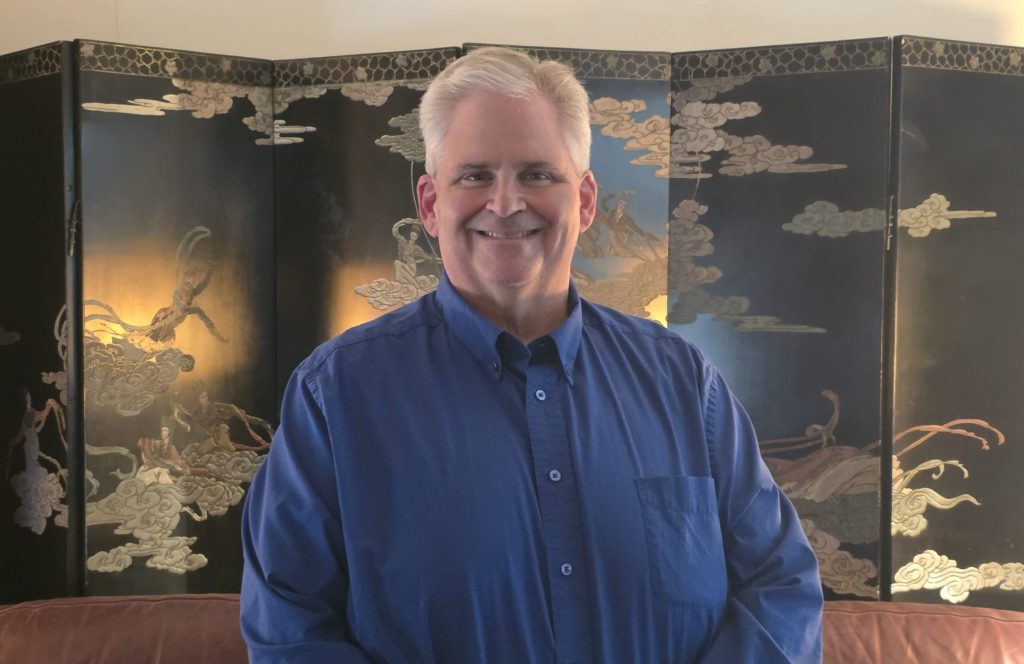
Former President George W. Bush first coined the phrase “compassionate conservative.” Blake Poindexter, ’89, practiced his own version as a longtime executive director of Wells County Community Corrections in his hometown of Bluffton, Indiana. Recently retired after a 35-year corrections career, he is still an advocate for alternative sentencing programs.
“I have been deeply committed to advancing rehabilitation, job placement, and successful reintegration for individuals involved in the justice system,” Poindexter said. “This has included collaborating with employers, substance abuse counselors, and mental health professionals to expand opportunities for individuals seeking to rebuild their lives and contribute positively to their communities.”
It was not necessarily the career path he envisioned after graduating from Hillsdale with a degree in communications.
“Unfortunately, we were in a cycle where they were not hiring management in the U.S.,” Poindexter said of the job market in 1989. “My dad was getting ready to have open heart surgery, so I stuck around in Bluffton and read about this new startup department for alternative sentencing called community corrections. They were looking for a full-time field officer. I thought maybe I could do this for a couple of years until the market employment situation got better.”
He was hired as a field officer with Wells County Community Corrections and a reserve deputy with the Wells County Sheriff’s Department. He was soon charged with deploying a new technology called GPS electronic monitoring, which would provide an alternative to incarceration to help courts maintain accountability and reduce jail overcrowding. In 1993, he was named the executive director of the WCCC and worked to develop “cornerstone” programs implementing evidence-based practices to improve outcomes and increase public safety.
“We were an alternative to brick-and-mortar jails and prisons,” he said of his time at WCCC. “We were utilizing developing alternative sentencing of having people in their home serving an executed sentence for a criminal offense. They’re responsible for their own rent, their own food, their own medical, so it’s not a strain on the state or the county.”
He said working firsthand with many of his “clients” gave him an appreciation for the criminal justice process.
“It allowed meto work with the family unit, trying to reunify the family and make sure we weren’t losing just the offender, but the spouse and family members due to their incarceration,” Poindexter said. “I’ll see people when I’m out and about who I’ve had on the program 15, 20, 25, or 30 years ago. They stop me and say, ‘Hey, you know you had me on a drug addiction issue. You were tough, but when I would come in weekly to check in, you would take the time, sit down, talk to me and see how I was doing, see how the job was going, and see how my counseling program was progressing. You held me accountable.’”
He said establishing GED and job placement programs was also key to long-term success.
“One of the things that I observed was their lack of a high school diploma,” he said. “You have to have that just to get in the door at any company, so we started and ran the GED program. Once we got them [a high school diploma], then I could get them into job placement.”
Poindexter said he managed more than 13,000 cases over his career. Despite that large caseload, he said he remains optimistic about the future.
“I never got pessimistic about it,” he said. “I still am very optimistic. It’s easy with all the media and social media platforms to get very discouraged. I always remind folks, ‘Don’t look at all that. Look around you. Get off the screen, because the proof is what you’re seeing, not what you’re reading on a flat, one-dimensional device.’”
After retiring from the WCCC, he entered the private sector, founding the Applied Logistics Group, LLC. He also serves as vice president of Business Development for Geosatis, a company specializing in GPS electronic monitoring technology for criminal justice systems.
“In this role, I work with agencies across the United States and internationally to implement and enhance alternative sentencing programs, drawing on my decades of experience in community corrections,” Poindexter said.
He and his wife, Lauriean, remain community focused, including being involved in the Fort Wayne Children’s Foundation, where Blake served as president. He also serves in several clubs and organizations, including as a founding board member of the Wells County Boys & Girls Club.
Poindexter followed his older brother, Clay, ’85, to Hillsdale College, where he was impressed by the handwritten note he received from then-Dean of Admissions Dr. Thomas Conner. Completing advanced studies in Shakespearean and Renaissance literature at the University of Oxford, Poindexter was involved with theatre and music during his time on campus. He also helped run and manage the family-owned Hillsdale Subway restaurant franchise during his time as a student.
He said the liberal arts education received at Hillsdale proved valuable both personally and professionally.
“As you get out into the world, you start realizing more and more what Hillsdale did for you,” said Poindexter, who was a member of the Phi Sigma Epsilon fraternity. “I’m a big supporter of a broad liberal arts degree that opens up many topics and gives you multiple perspectives. When I look back at my degree from Hillsdale, I had a broad-based education that gave me a lot of knowledge.”
Doug Goodnough, ’90, is Hillsdale’s senior director of Alumni Marketing. He enjoys connecting with fellow alumni in new and wonderful ways.
Published in June 2026
